
Review · THE NETHERLANDS
Rotterdam & Gouda Private Daily Walking Tour
Rotterdam and Gouda make an excellent pair: one is a city of daring bridges, rebuilt streets, and sharp modern design, while the other gives you canals, old guild buildings, cheese, and a medieval core. This seven-hour private tour connects both without asking you to plan the route yourself. Guide Alex has led the experience, using stories to link Rotterdam’s wartime destruction with Gouda’s long trading life.
I like the small group size, capped at four, and the mix of famous sights with less obvious stops such as the former ash warehouse, Lazarus Gate, and a medieval tapestry workshop. I also like that the Red Lion windmill entrance and coffee or tea are included. The main drawback is time: 28 stops in seven hours means most visits are brief, and several major interiors cost extra.
Key points at a glance
- Two very different Dutch cities in one day: Rotterdam brings bold architecture and port history; Gouda brings cheese, churches, and medieval lanes.
- A genuinely private format: The group limit is four, with possible pickup in Rotterdam, Gouda, or selected Amsterdam locations.
- Rotterdam’s best visual sequence: Markthal, the Cube Houses, Oude Haven, De Hef, and Erasmus Bridge create a strong run of city highlights.
- Gouda is more than cheese: You also see Saint-John Church, the old city hall, former guild buildings, a leper-house gateway, and a working-looking historic windmill.
- Budget for added admissions: Saint-John Church costs €11 per person, Gouda Cheese Experience €16, and public transportation €15 per person.
- A flexible but fast-paced day: The route includes many ten-minute stops, so you get broad coverage rather than long museum visits.
Rotterdam begins with architecture and survival
The day starts at 9:00 am, with pickup available at the Port of Rotterdam on Wilhelminakade 909. Hotel pickup in Rotterdam or Gouda can be arranged, and pickup is also offered at Amsterdam Central Station, Amsterdam Passenger Terminal, or Dam Square. Since the tour ends back at the meeting point, confirm the pickup details before booking, especially if you are coming from outside Rotterdam.
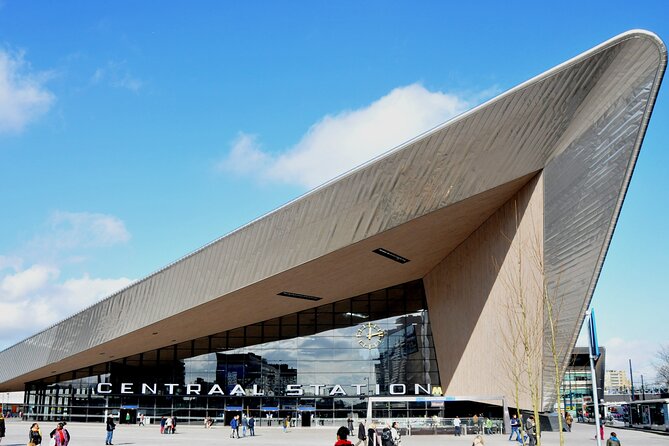
Rotterdam Centraal is a fitting first stop. The station handles about 170,000 passengers a day and has become one of the city’s major architectural sights. You get only ten minutes here, so use it to look up and around rather than treating it as a simple transport hub. The wide, modern design sets the tone for the rest of Rotterdam.
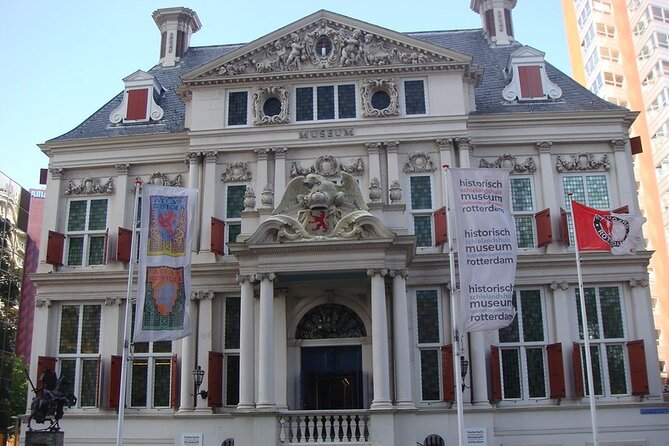
The former headquarters of the Schieland water authority offers a quick change of pace. This 17th-century building reflects the Netherlands’ long fight to manage water, and it was once temporary accommodation for Napoleon Bonaparte. The visit lasts ten minutes, and admission is not included, so think of this as a guide-led exterior and history stop unless you choose to pay for entry.
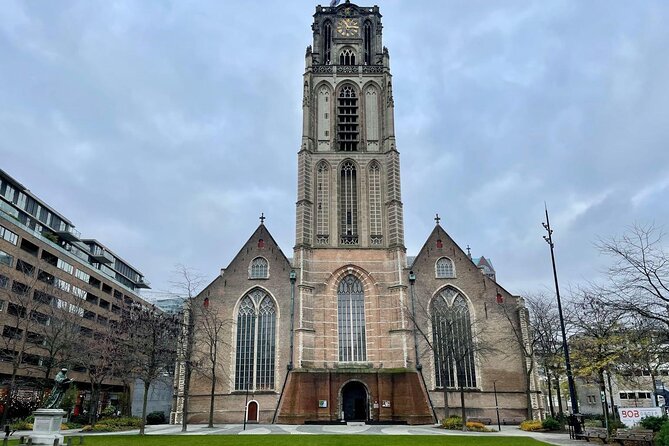
Next comes Grote of Sint-Laurenskerk, Rotterdam’s oldest building, dating from 1525. Its late Gothic design is especially striking because it survived the Nazi bombing of May 15, 1940, when much of central Rotterdam was destroyed. You have ten minutes here, and admission is extra. If church interiors matter to you, ask how much time the schedule allows before deciding to enter.
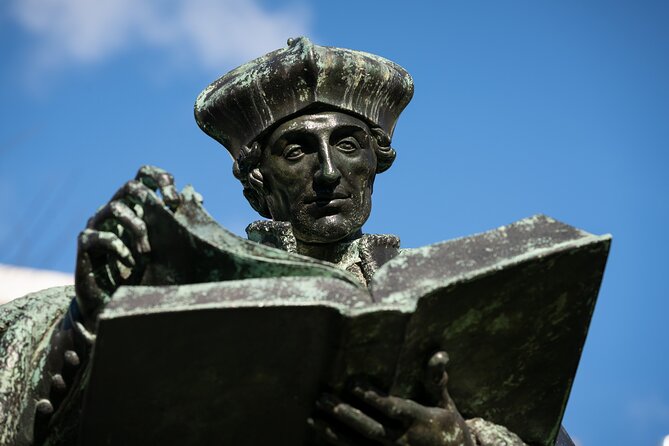
The Erasmus Monument honors Desiderius Erasmus of Rotterdam, the 16th-century philosopher, theologian, scholar, and priest. The stop is free and brief, but it helps explain why Erasmus appears across the city in the names of public buildings and institutions. I like this kind of pause because it puts a person behind the place name.
More Cheese Walking and Food Tours in the Netherlands
- 2-Hour Walking Tour in Gouda All inclusive
★ 5.0 · 48 reviews - Amsterdam Walking Tour and Cruise with Drinks and Cheese Tasting
★ 4.0 · 30 reviews - Amsterdam canal cruise with culinary burger or cheese & wine
★ 4.2 · 29 reviews
Markthal and the Cube Houses show Rotterdam’s playful side
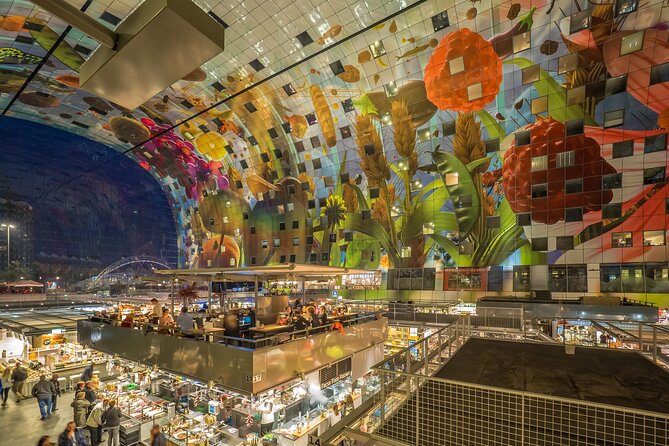
Markthal is one of the day’s strongest visual stops. The horseshoe-shaped building combines an indoor market with housing and other facilities. Its huge interior artwork has earned it the nickname the Sistine Chapel of Rotterdam. You get fifteen minutes, enough to see the central space and take in the unusual combination of food hall, apartments, and public architecture.
The nearby Cube Houses are even stranger. These tree-like structures place cube-shaped apartments on top of supporting columns. Their tilted form makes some of the interior space difficult to use, with only about three-quarters suitable for ordinary living. The tour includes twenty minutes here and admission to Kijk-Kubus, the show apartment, so you can better understand how the design works from inside.
That included entry adds real value. From the street, the Cube Houses look like a clever photo stop. Inside, you can judge the practical tradeoff for yourself. I would give this extra attention if you enjoy architecture, design, or unusual homes. If you prefer traditional streets and old interiors, this will still be interesting, but it may not be a highlight.
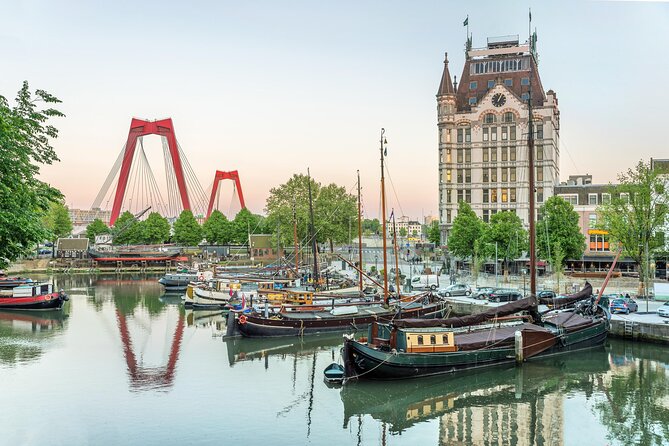
Oude Haven gives you a more relaxed setting. It was one of medieval Rotterdam’s early ports, near the former mouth of the River Rotte and the New Meuse. Today, cafés, restaurants, taverns, and clubs fill the area. The stop lasts twenty minutes, which gives you time to see the water and absorb the contrast between the old harbor setting and the new city around it.
Witte Huis follows. At the end of the 19th century, this was considered Europe’s tallest skyscraper, and it was one of the few buildings to survive the 1940 destruction. The ten-minute stop is short, but the building carries a useful lesson: Rotterdam’s modern identity did not begin after the war. It had already been experimenting with height and new construction.
Bridges, war memory, and the working port
Willemsbrug, often called the Red Bridge, links Rotterdam’s central and northern areas with southern districts. It is one of three major bridges in this part of the city and is dedicated to Willem III. You spend ten minutes here, likely focusing on the color, structure, and views along the New Meuse.
De Hef is a large steel lift bridge that once carried trains across the river. It served before a rail tunnel was built under the New Meuse. The bridge no longer functions as a regular rail crossing, but its machinery and industrial scale make it an important reminder of Rotterdam’s transport past. Again, the stop is ten minutes, so expect an informed look rather than a long walk around the structure.
At the Monument to the Merchant Navy, the tone turns serious. De Boeg memorializes the 3,500 people aboard Dutch merchant ships who died during World War II. Its position on the river embankment connects the memorial to the shipping routes and port life that shaped Rotterdam. I value this stop because it prevents the city’s modern architecture from becoming only a design tour.
Leuvehaven is an open-air maritime museum with historic steamships, cargo-handling machinery, ship engines, and other equipment dating from the mid-19th century through the 1970s. You have twenty minutes, and admission is listed as free. This is one of the better places to connect Rotterdam’s grand port reputation with the tools that made the work possible.
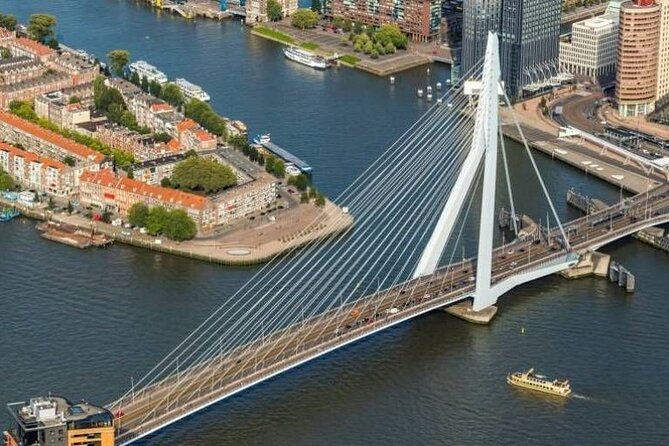
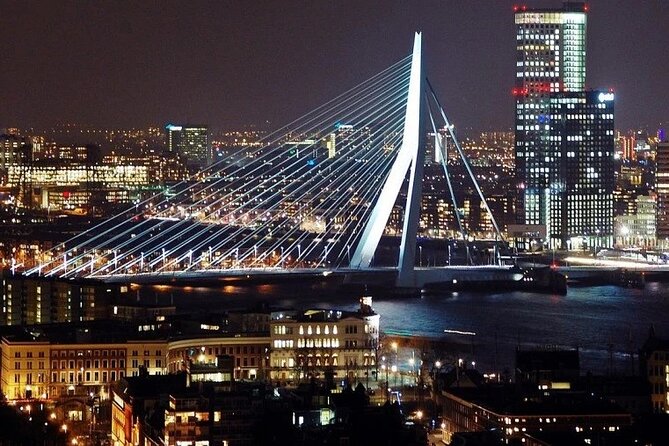
The Erasmus Bridge is the final Rotterdam highlight. Known as The Swan or The Harp, it is one of the city’s defining images. The bridge rises 139 meters, and its opening section is 80 meters long, described as the largest and heaviest opening bridge section in Europe. The twenty-minute stop should give you time for photographs and a clear view of the cable design.
The Rotterdam section works best as a moving overview. You see the city’s station, old church, market hall, bridges, port machinery, and memorials in one sweep. The tradeoff is that almost every stop is ten or twenty minutes. You will not have much time for shopping, extended museum visits, or sitting beside the river.
Gouda starts with cheese, not just a postcard
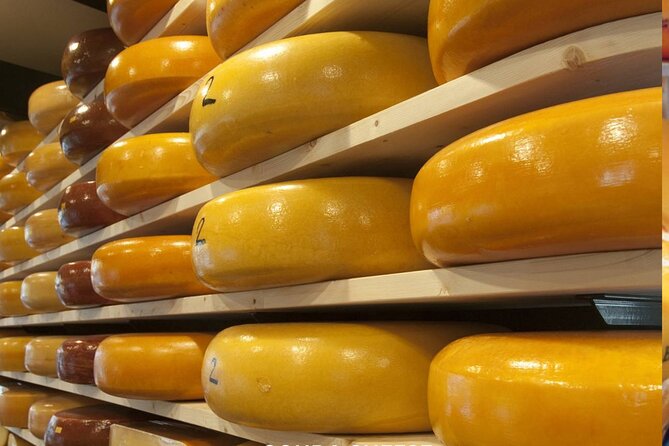
The move to Gouda changes the feel of the day. The Gouda Cheese Experience is scheduled for 45 minutes and combines entertainment, tasting, and education at a cheese museum and factory. Admission costs €16 per person, so add that to your budget if you want the full experience.
I would not skip it if you are curious about the product that made Gouda famous. The stop gives the town a practical entry point before you walk its streets. You also have a chance to buy cheese, as Alex’s family guests did, and cheese keeps well enough to make a useful edible souvenir.
The next stop is Gouda’s city hall, built in 1459 and described as the oldest existing city hall building in the Netherlands. You get fifteen minutes, with admission not included. Its age and position help you read the square as a civic center, not simply as a backdrop for photographs.
At VVV Gouda, you see a 1668 custom house linked to the cheese trade. This is a small but useful detail. Gouda’s identity was built through commerce, storage, weighing, and movement, not only through attractive old façades.
Arti Legi adds another layer. The building has served several purposes in the city’s past, making it one of Gouda’s more historically varied structures. The visit lasts ten minutes. Since the itinerary includes many buildings with changing uses, you get a sense of how old Dutch urban spaces were adapted rather than replaced.
Same region, a different wheel:
- Amsterdam Classic Saloon Boat Cruise with Drinks and Cheese
★ 5.0 · 31,825 reviews - Amsterdam: Classic Saloon Boat Cruise with Cheese & Wine
★ 4.6 · 27,035 reviews - Amsterdam: Guided Zaanse Schans, Windmills & Cheese Tour
★ 4.4 · 4,826 reviews - Zaanse Schans Windmills, Clogs and Dutch Cheese Small-Group Tour from Amsterdam
★ 4.5 · 2,369 reviews
Saint-John Church and Gouda’s complicated past
Saint-John Church is the longest church in the Netherlands and is famous for its 72 stained-glass windows. You have ten minutes, while entry costs €11 per person. That is not much time for a full church visit, so decide in advance if the windows are a priority. If you pay to enter, you may want to ask the guide whether the schedule can be adjusted.
Museum Gouda occupies the former St. Catherine Gasthuis, formed from two buildings that became one national monument. Its past includes use as a mental hospital, prison, torture chamber, art building, and horse stable. Admission is not included, and the allotted fifteen minutes is more of a brief introduction than a proper museum visit.
Tapijthuis is another compact but memorable stop. It began as a medieval workshop for Flemish tapestry weavers, later housed a secret Catholic children’s school, then became a 19th-century brewery and eventually an art studio and gallery. Ten minutes is enough to hear the outline, but not enough to explore every chapter.
The garden behind the Willem Vroesenhuis offers a quieter pause. The elderly house was founded by the prominent citizen Willem Vroesen, and its rear yard is described as picturesque. You get ten minutes. This is the kind of stop that rewards slower eyes, especially after the churches and public buildings.
Lazaruspoortje is a five-minute visit to a well-known gateway connected with a former house for people suffering from leprosy. It is followed by De Visbanken, a former fish market established in the mid-16th century. Each stop lasts only five minutes, so these are quick visual markers within the old quarter.
Guilds, ash, and a working windmill
The Evangelical Lutheran church is dedicated to Saint Joost, patron of bag carriers and the guild connected to them. The ten-minute stop gives you a glimpse of how craft groups and religious life once overlapped in Gouda.
Asschuur is an especially unusual detail. This mid-19th-century house served as an ash warehouse when potash was used in soap and glass production. It is easy to miss a building like this if you only follow the main sights, but it points to the ordinary industries that supported city life.
The Red Lion Windmill is one of the day’s included admissions. De Roode Leeuw is among the oldest surviving flour mills in the Netherlands and retains its original shape inside and out. You have fifteen minutes here. The included ticket makes this stop a better value than several of the optional interiors, and it gives the day a clear connection to food production after the cheese visit.
The Remonstrantse Kerk belongs to the Remonstrant Brotherhood, a Protestant movement that split from the Dutch Reformed Church in the early 17th century. Ten minutes is enough for a short explanation and exterior look, though admission is not listed as an extra cost.
The final stop is Weeshuis, a former orphanage dating from 1643 that now operates as a highly rated, exclusive hotel. You get five minutes. It is a fitting last glimpse of Gouda’s changing buildings: a place created for children in need now serving a very different purpose.
What the $592.56 private price really buys
The cost is $592.56 per group of up to four, not per person. For four people, that works out to about $148 per person before extra admission and transport costs. For two people, the per-person cost is much higher, but you still receive a private guide and a full seven-hour day.
The value rests in the route and the flexibility. You cover two cities, receive coffee or tea, enter the Red Lion Windmill and Kijk-Kubus, and avoid having to coordinate the Rotterdam to Gouda portion yourself. A private group also makes it easier to ask questions or adjust emphasis, though the tour still has a lot to cover.
Budget separately for €11 per person for Saint-John Church, €16 per person for the Gouda Cheese Experience, and €15 per person for public transportation. The information states that transportation takes place within the seven-hour tour, but public transportation is not included, so clarify the exact transport plan and cost when you reserve.
The experience is best for a family or group of friends who want broad coverage, personal guiding, and a full day with no large bus group. It is less suited to you if your main goal is a slow museum visit, a long cheese tasting, or extended free time in either city.
Timing, pickup, and the smart way to plan
The advertised start is 9:00 am, and the tour lasts about seven hours. Because transportation is part of that time, the route does not give you seven full hours on foot. The stop lengths also show the pace clearly: many are ten minutes, some are five, and only a few reach twenty or forty-five minutes.
Wear comfortable shoes, since the day includes walking through city centers and historic quarters. Bring room in your budget for the optional admissions, and decide before departure which interior matters most to you. Saint-John Church and the Gouda Cheese Experience are the clearest paid choices, while the windmill and Cube House entry are already covered.
The maximum group size is four, and confirmation is provided when you book. Most people can participate, and the route is near public transportation. Free cancellation is available until 24 hours before the start time, but changes or cancellations inside that window are not accepted for a refund.
Should you book the Rotterdam and Gouda tour?
Book it if you want a private, tightly packed introduction to two very different Dutch cities. The strongest parts are the Rotterdam architecture run, the war and port context, the Gouda cheese visit, and the Red Lion Windmill. Alex’s ability to tell stories and handle small changes is a useful advantage for a day with this many moving parts.
Think twice if you want long visits inside churches and museums. This is a sampler with a personal guide, not a slow study tour. For a group of four, the price is easier to justify, especially with pickup and route planning included. For two people, compare the cost with arranging separate visits yourself.
FAQ
How long is the Rotterdam and Gouda tour?
The tour lasts approximately seven hours, including transportation time.
What time does the tour start?
The scheduled start time is 9:00 am.
Where does the tour start?
The listed starting point is the Port of Rotterdam at Wilhelminakade 909, 3072 AP Rotterdam.
Is hotel pickup available?
Yes. Pickup can be arranged from a hotel in Rotterdam or Gouda. Pickup is also possible from Amsterdam Central Station, Amsterdam Passenger Terminal, or Dam Square.
Where does the tour end?
The activity ends back at the meeting point.
How many people can join the private tour?
The maximum is four people.
Is the tour offered in English?
Yes. The tour is offered in English.
Is the Gouda Cheese Experience included?
No. Admission costs €16 per person.
Does the tour include entry to Saint-John Church?
No. Admission costs €11 per person.
What is included in the tour price?
Coffee or tea and entrance tickets to the Red Lion Windmill are included. Kijk-Kubus admission is also listed as included in the itinerary.
Is public transportation included?
No. Public transportation is listed as an additional €15 per person.
Can I cancel for a full refund?
Yes, if you cancel at least 24 hours before the experience start time. Cancellations or changes made less than 24 hours before the start are not refunded.
Freshly cut around the Netherlands
- Amsterdam: Zaanse Schans E-Bike Tour with Windmills & Cheese★ 4.5 · 12 reviews
- Zaanse Schans & Volendam Private Tour: Windmills and Cheese★ 5.0 · 5 reviews
- Volendam: 2.5-Hour Cheesemaking Workshop & Clog Making Tour★ 4.5 · 17 reviews
- Volendam: 2-Hour Clogmaking Workshop and Cheese Tour★ 3.9 · 17 reviews
- Rotterdam- Kinderdijk -Cheese Farm Experience min 4 max 100 PP★ 4.0 · 9 reviews
- Private tour from Rotterdam to Windmills of Kinderdijk & Gouda Cheese Experience★ 5.0 · 3 reviews
- Haarlem Cheese and Wine Cruise★ 4.5 · 7 reviews
- Discover Gouda with a self-guided Outside Escape city game tour!★ 5.0 · 13 reviews
Cheese Walking and Food Tours, plate by plate.

Paris: Montmartre Cheese, Wine & Pastry Guided Walking Tour
Read our review →
Paris Le Marais Food Tour With 10+ Tastings, Cheese, Wine & More
Read our review →


Paris St Germain Food Tour with Cheeses, Foie Gras, Wines & More
Read our review →
Cheese lists with this tasting